
Bamboo Insurance Services, Inc. (BMB) is preparing to offer 35.0 million shares of Class A common stock on the New York Stock Exchange at an expected price of $18.00 to $20.00 per share. At the $19.00 midpoint, the selling stockholders would receive approximately $665.0 million, while the company would command an implied market capitalization of approximately $2.97 billion. Bamboo will not receive any proceeds from the offering. J.P. Morgan and Morgan Stanley are leading the deal, with Deutsche Bank Securities, Evercore ISI, Wells Fargo Securities, Barclays, Goldman Sachs, Piper Sandler, CVC Capital Markets, Dowling & Partners Securities and Wedbush Securities also participating.
Bamboo is an AI- and technology-enabled homeowners insurance managing general underwriter, or MGU. Rather than retaining most of the insurance risk on its own balance sheet, Bamboo originates and underwrites policies while partnering with insurance carriers, reinsurers and institutional investors that supply the underlying capacity. This capital-light structure allows the company to earn commissions and fees while assuming only a limited portion of the losses associated with the policies it places.
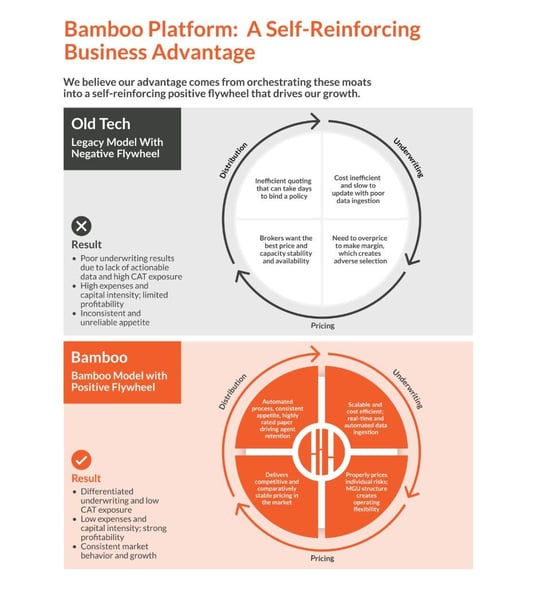
The company was founded in 2017 and initially built its business in California, one of the country’s largest and most challenging homeowners insurance markets. Bamboo has since entered Texas and is preparing to expand into additional states. Its target market consists primarily of mid-market homes with limited catastrophe exposure, rather than properties located in the highest-risk wildfire, hurricane or other catastrophe zones.
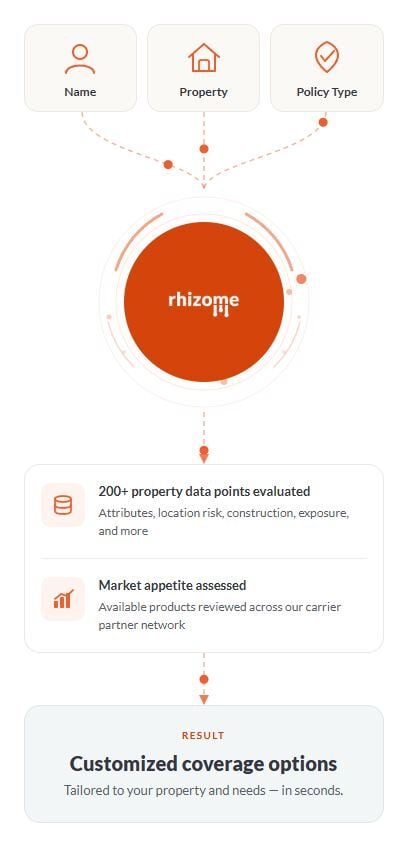
Bamboo’s technology platform combines more than 200 data inputs covering weather, property characteristics, aerial imagery, geospatial information and catastrophe exposure. Its proprietary Rhizome technology evaluates risks at the individual-address level, directs applicants toward the appropriate product and capacity provider and monitors geographic exposure in real time. The platform also incorporates AI into underwriting and claims workflows, including the analysis of roof imagery, inspection reports and potential indicators of fraud.
Approximately 88% of Bamboo’s policies were processed from quote to bind without manual intervention during 2025. The company says its distribution partners can generally obtain a quote in less than five minutes, while approximately 75% of quotes were eligible to be bound as of February 2026.
Bamboo had 401,787 policies in force during the 12 months ended June 30, 2026, with $879.3 million of managed premium. Managed premium increased 58% during 2025 and another 34% during the first six months of 2026 compared with the prior-year period. Its trailing-12-month policy retention rate reached 88%, up from 85% in 2024.
The company generated $271.2 million of total revenue during 2025 on a combined predecessor and successor basis, an increase of approximately 51% from $179.8 million in 2024. Combined 2025 net income was approximately $33.5 million, compared with $31.6 million in 2024. Adjusted EBITDA rose 77% to approximately $104.2 million, producing an Adjusted EBITDA margin of roughly 38%, compared with $58.8 million and a 33% margin in 2024.
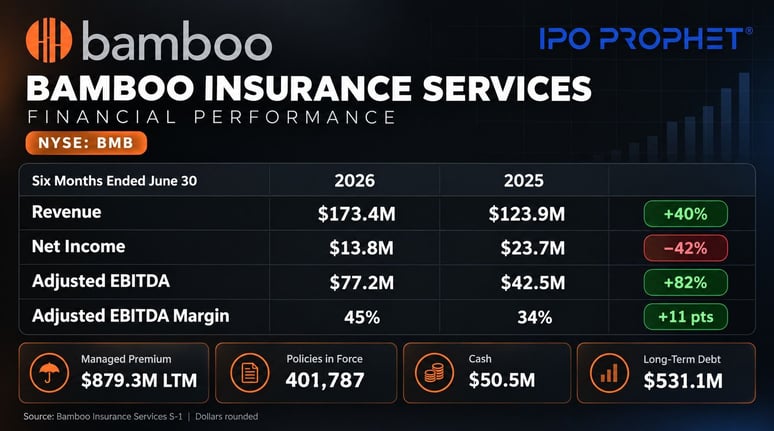
Growth remained strong during the first half of 2026. Revenue increased 40% to $173.4 million from $123.9 million during the first six months of 2025. Adjusted EBITDA climbed 82% to $77.2 million from $42.5 million, while the Adjusted EBITDA margin expanded to 45% from 34%.
GAAP earnings moved in the opposite direction, however. Net income declined to $13.8 million during the first six months of 2026 from $23.7 million in the comparable 2025 period, reducing the net margin to 8% from 19%. Higher interest expense and amortization of acquired intangible assets weighed on reported profitability. Interest expense increased to $16.3 million from $5.0 million, while amortization expense rose to $36.4 million from $8.0 million.
Operating cash flow remained healthy, increasing to $52.4 million during the first six months of 2026 from $37.9 million a year earlier. Bamboo finished June with $50.5 million of cash, $2.01 billion of total assets, $735.1 million of liabilities and $531.1 million of long-term debt. The company will not receive fresh capital from the IPO to reduce that leverage because every share in the offering is being sold by existing investors.
Bamboo’s underwriting results are central to its investment case. The company reported an attritional loss and loss-adjustment-expense ratio of 35% in 2025. Over the last five fiscal years, its average gross loss and LAE ratio, including catastrophe losses, was 55%, compared with a weighted average of 86% for the ten largest California homeowners insurers.
The January 2025 California wildfires provided a significant real-world test. Bamboo estimates that its programs incurred approximately $165 million of gross losses before subrogation, representing roughly 0.5% of residential insured losses outside the California FAIR Plan despite Bamboo holding approximately 4% of the market. The company attributes that result to its focus on address-level risk selection and limiting geographic concentrations.
Bamboo relies on outside capacity providers to assume nearly all the insurance risk generated by its platform. As of June 30, 2026, its network included seven program partners, 60 global reinsurers and 28 institutional investors. Those parties collectively assumed 94% of the quota-share premium associated with policies sold during 2025.
The network has expanded from 12 capacity providers in 2021 to 95 in 2026, and the largest individual quota-share provider represented approximately 14% of premium at risk. All of the providers carry an A.M. Best financial-strength rating of A- or higher or are fully collateralized.
There is still meaningful concentration within Bamboo’s program-carrier relationships. Sutton represented 78% of commission revenue during the period from January 1 through December 4, 2025. Bamboo launched four programs with new partners during 2025 and expects Sutton’s contribution to decline as those relationships grow, but the loss or reduction of a major capacity arrangement could materially restrict the company’s ability to write or renew policies.
The company also maintains a Bermuda-based captive reinsurer that retains a limited portion of the risk it underwrites. Participation is typically around 5% for mature programs and can reach approximately 20% for newer programs. Aggregate captive participation was 5% during 2025, and Bamboo reduced its retained share in its largest program from 2.5% to zero in April 2026.
At the $19.00 midpoint, Bamboo’s approximately $2.97 billion implied valuation represents roughly 11 times combined 2025 revenue and approximately 28.5 times combined 2025 Adjusted EBITDA. Based on annualized first-half 2026 revenue and Adjusted EBITDA, the valuation falls to approximately 8.6 times revenue and 19.2 times Adjusted EBITDA. Those multiples require investors to place considerable value on Bamboo’s growth rate, improving Adjusted EBITDA margins and ability to reproduce its California underwriting results in new markets.
The offering is structured as an Up-C transaction. Following the IPO, Bamboo Insurance Services will serve as the publicly traded holding company and sole manager of Miramar Holdco, the operating business. Public-company shareholders will own Class A shares, while continuing equity owners will hold non-economic Class B voting shares paired with interests in Miramar Holdco.
Bamboo will also enter into a tax receivable agreement requiring it to pay the continuing equity owners and blocker shareholders 85% of certain tax benefits realized through future exchanges and other transactions. These payments could become significant and reduce cash otherwise available to public shareholders.
CVC acquired a controlling interest in Bamboo from White Mountains Insurance Group in December 2025. Following the IPO, CVC is expected to retain approximately 61% of the company’s total voting power, or approximately 58% if the underwriters exercise their overallotment option in full. Bamboo will therefore qualify as a controlled company under NYSE rules and plans to take advantage of exemptions from certain independent-board and compensation-committee requirements.
The entirely secondary nature of the offering deserves particular attention. CVC Blocker Holdco and Miramar Blocker Holdco are selling all 35.0 million shares, with an additional 5.25 million shares available to cover overallotments. Bamboo will receive none of the proceeds but expects to bear approximately $12.4 million of offering expenses.
Bamboo presents a compelling combination of rapid growth, recurring commission revenue, strong policy retention, expanding Adjusted EBITDA margins and limited direct exposure to insurance losses. Its performance through California’s difficult homeowners insurance environment also gives the company a differentiated underwriting record.
Investors must balance those strengths against a premium valuation, $531 million of long-term debt, dependence on third-party capacity providers, concentration in California and Texas, catastrophe exposure, declining GAAP earnings during the latest interim period and an ownership structure that leaves CVC firmly in control. With no primary capital entering the business, the IPO functions principally as a liquidity event for existing shareholders and a path toward a public market for Bamboo’s stock.