
Quantinuum Inc. (NASDAQ: QNT) is seeking to raise approximately $1.43 billion in its initial public...

Cerebras Systems Inc. has filed for an initial public offering on the Nasdaq under the ticker “CBRS,” offering 28.0 million shares of Class A common stock at an expected price range of $115 to $125 per share. At the midpoint price of $120, the offering would raise approximately $3.36 billion before underwriter options and imply an estimated post-offering market capitalization of approximately $25.5 billion based on 212.97 million shares outstanding after the offering. Including the full exercise of the 4.2 million-share overallotment option, the fully diluted post-offering market capitalization would increase to approximately $26.1 billion. Morgan Stanley, Citigroup, Barclays, and UBS are leading the deal alongside a broad syndicate of AI-focused and technology underwriters.
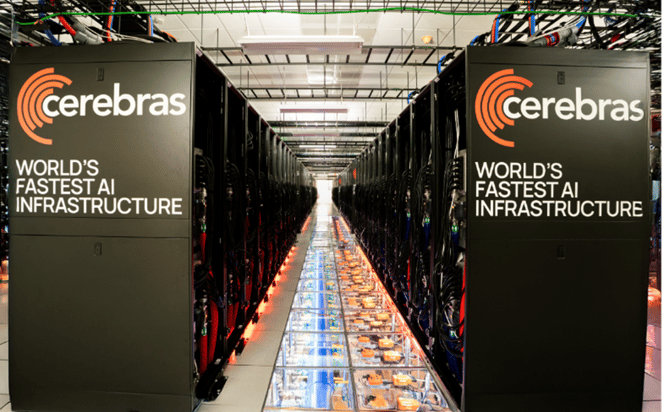
Unlike many recent AI IPO candidates focused primarily on software applications or model development, Cerebras is fundamentally an AI infrastructure company. The company has spent nearly a decade developing a radically different approach to artificial intelligence compute, centered around what it describes as the world’s first commercially viable wafer-scale processor. Rather than using clusters of smaller chips linked together through increasingly complex networking architectures, Cerebras built a processor that uses an entire silicon wafer as a single chip.
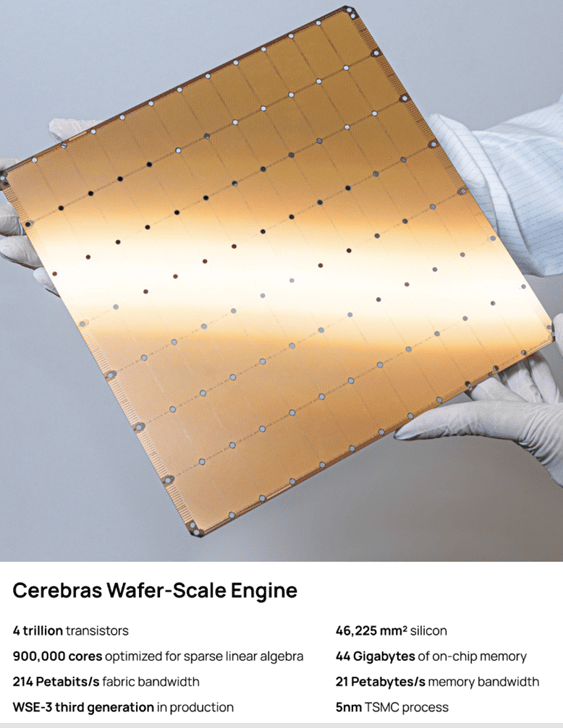
The scale of the technology is central to the investment narrative. Cerebras states that its third-generation Wafer-Scale Engine (“WSE-3”) contains 4 trillion transistors, 900,000 compute cores, 44 gigabytes of on-chip memory, and 21 petabytes per second of memory bandwidth. The processor spans 46,225 mm² of silicon and is built on TSMC’s 5nm process. According to the filing, the WSE-3 is approximately 58 times larger than NVIDIA’s B200 chip and provides 2,625 times more memory bandwidth than NVIDIA’s B200 package.
That architectural difference sits at the core of Cerebras’s positioning against the dominant GPU ecosystem. Management argues that modern AI workloads are increasingly communication-bound rather than purely compute-bound, meaning the movement of data between chips has become a critical bottleneck. By keeping significantly more compute and memory on a single piece of silicon, Cerebras believes it can reduce latency, lower power consumption, and dramatically improve inference speed. The company claims its systems can deliver inference speeds up to 15 times faster than leading GPU-based alternatives on benchmarked open-source models.
The timing of the offering reflects a major transition occurring inside the AI market itself. Much of the first wave of generative AI infrastructure spending centered on model training, where hyperscalers and foundation model companies raced to build increasingly large large-language models. Cerebras is instead leaning heavily into the next phase of the market: inference. The company argues that the emergence of reasoning models and inference-time compute is dramatically increasing the amount of compute required after models are already trained.
That shift matters because inference economics favor speed and latency advantages. Cerebras repeatedly compares fast AI infrastructure to the transition from dial-up internet to broadband, arguing that faster response times fundamentally expand user engagement and unlock entirely new categories of applications. The filing points to AI coding agents, deep research systems, and real-time voice applications as early examples where inference latency directly impacts usability and customer adoption.
The company’s recent customer wins have significantly increased investor attention around the IPO. In January 2026, Cerebras announced a multi-year agreement with OpenAI valued at more than $20 billion, under which OpenAI agreed to deploy 750 megawatts of Cerebras compute infrastructure and co-design future AI models optimized for Cerebras hardware. The scale of that agreement transformed Cerebras from a niche semiconductor story into a strategic AI infrastructure platform with direct exposure to one of the largest compute spenders in the industry.
Cerebras also disclosed a strategic partnership with Amazon Web Services to deploy Cerebras systems directly within AWS data centers. The partnership is particularly important because it potentially provides Cerebras with hyperscaler-scale distribution while allowing AWS customers to access Cerebras inference infrastructure through existing cloud workflows. The company additionally highlighted integrations with Microsoft Marketplace, IBM watsonx, Hugging Face, OpenRouter, and Vercel AI Gateway.
From a business model perspective, Cerebras is evolving from a predominantly hardware sales company toward a hybrid AI infrastructure platform combining hardware, cloud consumption, recurring inference revenue, and AI services. The company currently offers on-premises AI supercomputers, dedicated cloud deployments, inference-as-a-service, and hybrid deployment options for enterprise and sovereign AI customers.
That transition appears to be accelerating revenue growth dramatically.

Revenue increased from $24.6 million in 2022 to $78.7 million in 2023 before surging to $290.3 million in 2024 and $510.0 million in 2025. The growth trajectory reflects both increasing AI infrastructure demand and expansion within large strategic customer accounts. Cerebras noted that its top ten customers increased aggregate spending by approximately 80% within 12 months of initial purchase.
The profitability picture is more nuanced than headline numbers suggest. While the company reported GAAP net income of $237.8 million in 2025 after a $481.6 million net loss in 2024, Cerebras also disclosed non-GAAP losses in both years after adjusting for stock-based compensation and fair value changes tied to forward contract liabilities. Investors will likely focus heavily on how sustainable margins become as the business transitions toward cloud inference and long-duration infrastructure deployments.
The IPO also arrives during a period of escalating investor enthusiasm around AI infrastructure companies more broadly. NVIDIA remains the dominant force in AI accelerators, but public market investors have increasingly shown interest in alternative architectures capable of addressing power efficiency, memory bottlenecks, and inference scaling challenges. Cerebras is attempting to position itself not simply as another chip company, but as a fundamentally different compute architecture built specifically for reasoning-heavy AI workloads.
The competitive landscape, however, remains intense. NVIDIA’s CUDA software ecosystem, massive installed base, and entrenched hyperscaler relationships represent substantial barriers to adoption. Cerebras itself acknowledges that a significant portion of revenue currently depends on a limited number of customers, including OpenAI, AWS, G42, and MBZUAI. Any slowdown in AI infrastructure spending, shifts in hyperscaler procurement strategy, or inability to maintain performance advantages could materially impact the company’s trajectory.
There are also execution risks tied to the company’s cloud expansion strategy. Cerebras historically generated most of its revenue from hardware sales, but future growth increasingly depends on scaling recurring inference and cloud-based offerings that require substantial data center investments and long-term infrastructure commitments.
Still, the broader AI infrastructure backdrop remains extraordinarily supportive. Cerebras cites Bloomberg Intelligence estimates projecting the combined AI training and inference infrastructure market to grow from $251 billion in 2025 to $672 billion by 2029, representing a 28% CAGR, with inference expected to grow more than twice as fast as training infrastructure.
Strategically, Cerebras may represent one of the clearest public-market vehicles for investors seeking direct exposure to the next generation of AI compute infrastructure beyond traditional GPU architectures. The company is not simply selling semiconductors; it is attempting to redefine how large-scale AI systems are built, deployed, and monetized.
The broader significance of the IPO may ultimately extend beyond Cerebras itself. If public investors embrace the offering, it could validate the market’s appetite for alternative AI infrastructure architectures and reinforce the idea that the AI compute stack is still early in its evolution. If successful, Cerebras could emerge as one of the defining infrastructure challengers of the AI era.
At the midpoint of the proposed range, Cerebras would debut with one of the largest valuations ever assigned to a newly public AI infrastructure company, making the IPO a major referendum on both the future of inference computing and investor confidence in the durability of the generative AI buildout.
Cerebras Systems will make its Nasdaq debut on Thursday, 5/14.