


City Therapeutics (CTY), a Cambridge, Massachusetts-based biotechnology company, plans to list on the Nasdaq Global Market, offering 9,722,222 shares at $17–$19 per share. At the $18 midpoint, the offering would raise approximately $175 million in gross proceeds and imply a $906 million post-offering equity valuation, based on approximately 50.3 million shares outstanding. Goldman Sachs, Jefferies, and Stifel appear as the principal underwriters on the prospectus cover, with Oppenheimer & Co. also participating. The underwriters have an option to purchase approximately 1.46 million additional shares, which would bring gross proceeds to approximately $201.3 million if exercised in full at the midpoint. The October 9 preliminary prospectus does not specify a trading date.
City is developing RNA interference, or RNAi, medicines designed to reduce the production of proteins involved in disease. These therapies act on messenger RNA before it can be translated into protein, potentially producing durable effects from infrequent dosing. The company’s platform combines RNA trigger engineering, delivery technologies, and target selection informed by human genetics. Its initial pipeline focuses on blood clot prevention, inherited vision loss, and anemia, while earlier programs seek to extend RNAi treatment into the eye and central nervous system.
The company’s experience is a central part of its pitch. According to the prospectus, members of City’s team contributed to the discovery, development, or commercialization of seven of the eight FDA-approved RNAi therapeutics cited in the filing. President and CEO Andrew Orth previously led launches of RNAi medicines, while the company’s scientific leadership includes veterans of Alnylam. City has raised approximately $238.8 million in equity capital since its inception in July 2023, with investors including ARCH Venture Partners, Fidelity Management & Research Company, Invus, and Viking Global Investors. That background supports the company’s ability to execute, but it does not establish that its own candidates will succeed.
Its lead candidate, CITY-FXI, targets Factor XI, a protein involved in harmful blood clot formation. City aims to prevent thromboembolic events while reducing the bleeding risk associated with conventional anticoagulation. Initial results from the first three single-dose cohorts of its Phase 1 trial in healthy volunteers showed greater than 60% Factor XI knockdown at 15 milligrams, close to 80% at 50 milligrams, and 85% three weeks after a 150-milligram dose. The company reported that treatment was generally well tolerated. Those results demonstrate early biological activity, rather than proof that the drug prevents clots or offers a superior bleeding profile in patients. Additional Phase 1 data are expected in late 2026, followed by a planned Phase 2 study in patients undergoing total knee replacement in mid-2027.
CITY-RBP4, the second candidate, targets the protein that transports vitamin A from the liver to the eye. The initial focus is Stargardt disease, an inherited condition in which toxic vitamin A byproducts accumulate in the retina and progressively impair central vision. City expects to initiate a Phase 1 trial in late 2026 and report initial data in mid-2027. The company is also exploring geographic atrophy associated with age-related macular degeneration, with a Phase 2 trial planned for late 2027. Its third candidate, CITY-TFR2, is designed to improve iron availability and address anemia, initially in patients with myelofibrosis. An investigator-initiated trial in China is expected to begin in late 2026, with data anticipated in mid-2027, alongside a planned company-sponsored Phase 1/2 study beginning in early 2027.
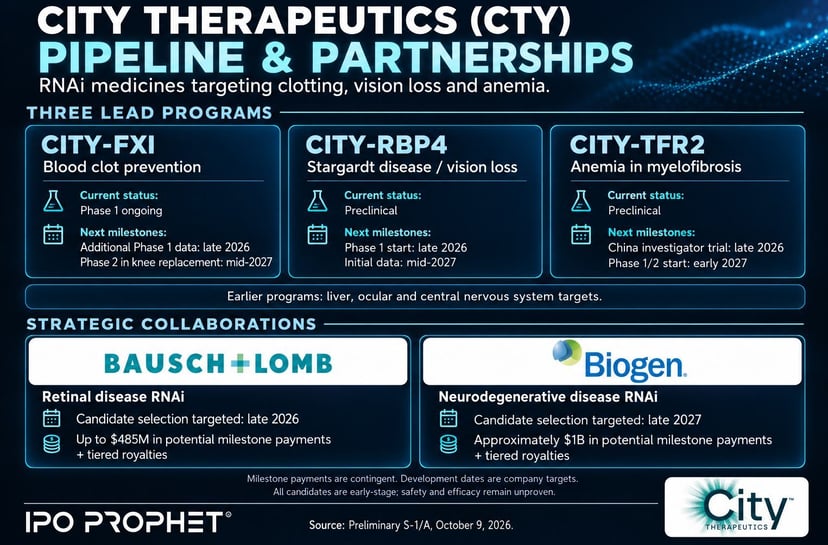
Partnerships add another dimension to the platform. Bausch + Lomb is collaborating with City on an RNAi treatment for retinal disease, while Biogen is working with the company on a program for neurodegenerative disease. The agreements include potential milestone payments of up to $485 million from Bausch + Lomb and approximately $1 billion from Biogen, plus royalties, subject to the contractual conditions. These headline amounts represent contingent opportunities, not committed revenue. City plans to enable Bausch + Lomb to select a development candidate by late 2026 and Biogen to select one by late 2027.
Financially, City is generating collaboration revenue but has no product sales. Collaboration revenue increased from $2.8 million in 2024 to $13.6 million in 2025, while net losses widened from $27.8 million to $58.5 million. For the first six months of 2026, revenue reached $6.4 million, compared with $5.6 million a year earlier, but research and development spending rose approximately 90% to $46.3 million. The first-half net loss more than doubled to $53.4 million, and operating cash use increased to $43.2 million from $7.1 million. The widening cash burn highlights the cost of moving multiple programs toward and through clinical trials.
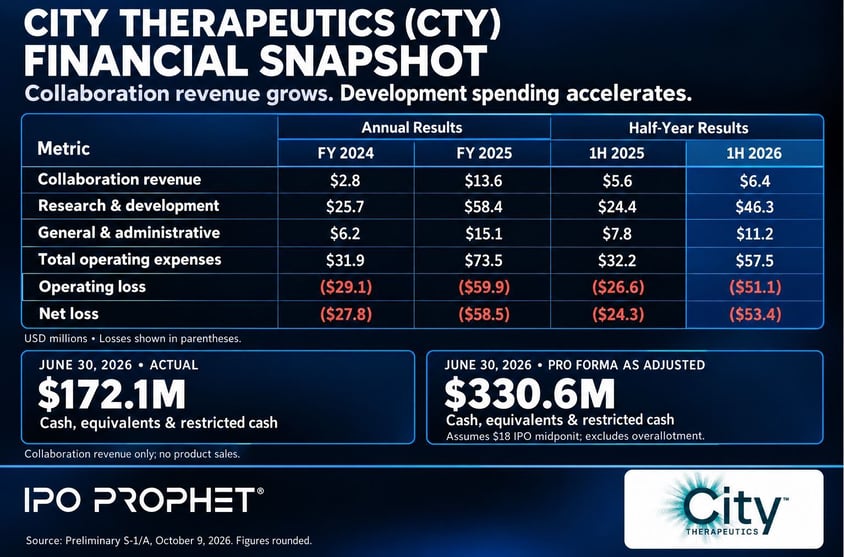
City estimated approximately $141.9 million in cash and cash equivalents as of September 30, 2026, a preliminary unaudited figure. At the IPO midpoint, it expects approximately $158.3 million in net proceeds before any exercise of the underwriters’ option. Management estimates that the offering proceeds and existing cash will fund operations into late 2028. Planned spending includes $30 million for CITY-FXI, $20 million for CITY-RBP4, $40 million for CITY-TFR2, and $70 million for platform development and additional candidates, using both existing cash and offering proceeds.
At roughly $906 million in equity value, the offering asks investors to assign substantial value to City’s scientific team, RNAi platform, and development potential before patient efficacy has been established. The partnerships provide external support for the technology, and the upcoming milestones create several opportunities to assess progress. The central question is whether early target suppression can translate into clinically meaningful benefits with acceptable safety. For investors, the next Phase 1 readouts and the transition into patient studies will be more informative than the size of the potential partnership payments.
City Therapeutics will debut on October 16th, 2026