Kestra Medical Technologies, a wearable cardiac device company, is set to go public on March 6,...

GMR Solutions Inc., also known as Global Medical Response, has filed for an initial public offering of 31.9 million shares of Class A common stock at a proposed price range of $22.00 to $25.00 per share, implying an offering size of approximately $750 million at the midpoint. The company has applied to list on the New York Stock Exchange under the ticker symbol “GMRS.” J.P. Morgan, KKR, BofA Securities, Barclays, Goldman Sachs, Citigroup, Evercore ISI, Morgan Stanley, UBS Investment Bank, Capital One Securities, Loop Capital Markets, Regions Securities LLC, and Strong Capital Markets are leading the offering. At the midpoint of the proposed range, GMR would command an estimated fully diluted market capitalization of approximately $4.7 billion.
GMR Solutions is the parent company of Global Medical Response, the largest provider of emergency medical services (EMS) in the United States and one of the largest integrated providers of alternate-site, out-of-hospital healthcare services. The company operates a nationwide emergency response infrastructure spanning approximately 1,400 U.S. counties and serving communities representing more than 60% of the U.S. population. GMR responds to roughly 10% of all 911 calls nationwide and approximately 37% of emergent air medical calls, positioning the company as a critical component of the U.S. healthcare and emergency response ecosystem.
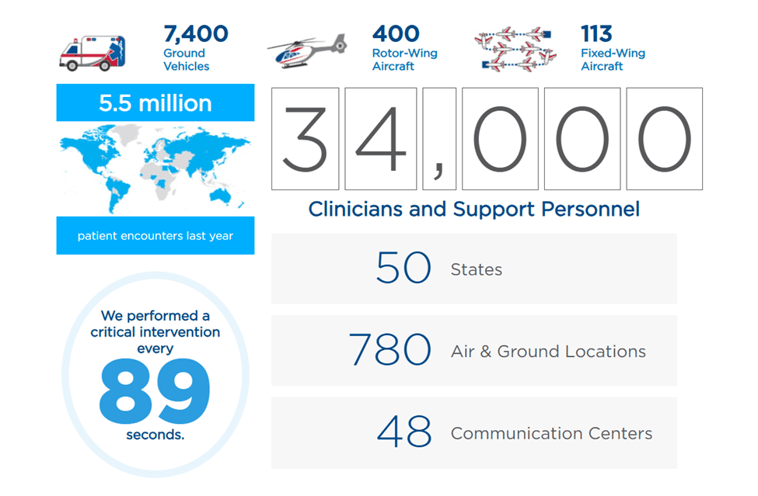
The company’s operations include a massive fleet of approximately 7,400 ground ambulances and vehicles, alongside 400 rotor-wing and 113 fixed-wing air ambulances operating from more than 780 physical locations across 45 states. GMR’s network is supported by 48 communications centers capable of dispatching services across all 50 states. The platform is staffed by more than 34,000 employees, including approximately 24,000 clinicians consisting of EMTs, paramedics, nurses, and affiliated physicians.
GMR traces its current scale and structure to the 2018 merger between Air Medical Group Holdings and American Medical Response, combining the leading air ambulance and ground ambulance providers into a single integrated platform. Since that merger, the company has expanded its coordinated care capabilities across emergent and non-emergent patient transport, disaster response, event medical services, and healthcare navigation solutions. The company increasingly positions itself not simply as a transportation provider, but as a broader alternate-site healthcare delivery platform integrated into hospital systems, payors, municipalities, and federal emergency response agencies.
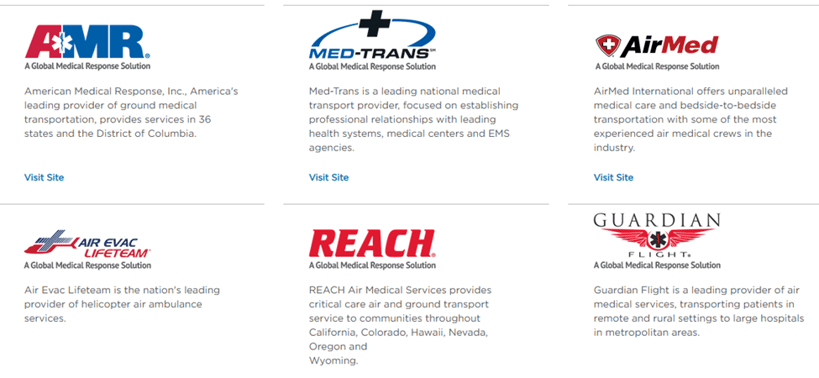
A key differentiator for GMR is its technology and care navigation infrastructure. The company developed its proprietary Transport.Net platform, which integrates dispatch, tracking, and transport coordination capabilities for both air and ground ambulance requests. Its RapidCall system is currently used by approximately 50% of all 911 access points and health systems, while its Concierge platform helps hospitals coordinate discharge transportation and patient flow. GMR has also developed a Nurse Navigation program designed to redirect low-acuity 911 calls to more appropriate care settings, helping reduce unnecessary emergency department utilization and ambulance deployments. As of the end of 2025, Nurse Navigation covered more than 19 million lives and redirected up to 20% of low-acuity 911 calls to alternate care settings.
The company believes multiple structural healthcare trends support long-term growth in EMS and alternate-site care. These include an aging U.S. population, increasing prevalence of chronic disease, rural hospital closures, shortages of primary care physicians, overcrowded emergency departments, and continued strain on healthcare infrastructure. GMR estimates its serviceable addressable market at approximately $18 billion to $20 billion today, growing from roughly $14 billion in 2018, within a broader total addressable market estimated at $35 billion.
Financially, GMR generated revenue of $5.74 billion in 2025, alongside net income of $206.2 million and Adjusted EBITDA of $1.19 billion. Revenue declined modestly year-over-year due primarily to divestitures of certain non-core businesses completed in late 2024, but profitability improved substantially as the company refocused on higher-margin core EMS operations and exited underperforming contracts. Management highlighted that revenue excluding divestitures grew at a compound annual growth rate of 10.3% from 2023 through 2025.
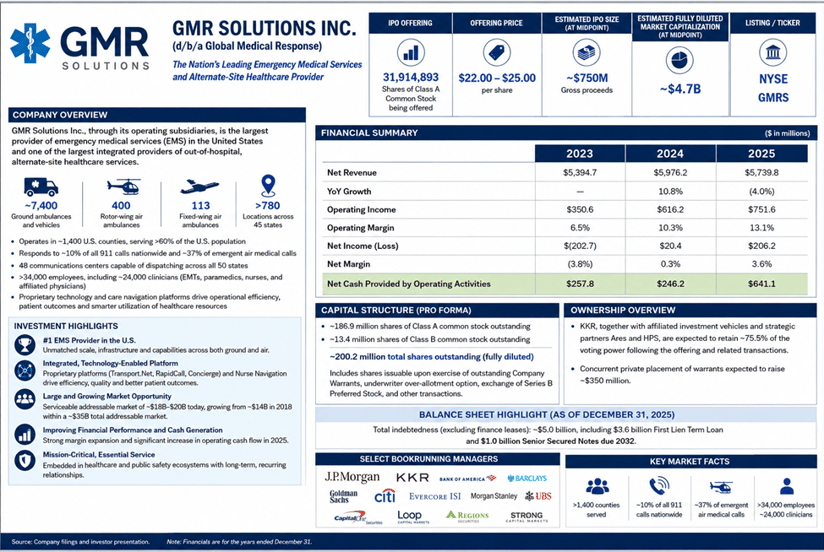
GMR enters the public markets carrying significant leverage. As of December 31, 2025, the company reported approximately $5.0 billion of indebtedness excluding finance leases, including a $3.6 billion first lien term loan and $1.0 billion of senior secured notes due 2032. While leverage remains elevated, management has emphasized that the company’s recurring revenue base, broad geographic diversification, and essential service positioning provide stability and predictable cash generation.
The ownership structure will remain highly controlled following the IPO. KKR, together with affiliated investment vehicles and strategic partners including Ares and HPS, is expected to retain approximately 75.5% of the voting power after the offering and related private placement transactions, making GMR a controlled company under NYSE governance standards. Concurrently with the IPO, certain existing investors are expected to purchase approximately $350 million of private placement warrants.
Comparable public companies include Acadia Healthcare, HCA Healthcare, Encompass Health, and other outsourced healthcare and emergency response providers. However, GMR’s scale across both ground and air EMS operations makes it somewhat unique within the public markets, particularly given its integrated national platform and mission-critical role in emergency healthcare delivery.
The IPO also arrives during a period of increasing investor focus on healthcare infrastructure, essential services, and alternate-site care delivery models. GMR’s positioning at the intersection of emergency response, logistics, and healthcare coordination could attract interest from investors seeking defensive healthcare exposure with operational scale and infrastructure-like characteristics.
GMR is expected to price its IPO on May 12th and trade on the NYSE under the ticker “GMRS” on May 13th.