
HMH Holding Inc. (HMH) began trading on April 1, 2026, with a subdued open, pricing at $20.00 and...
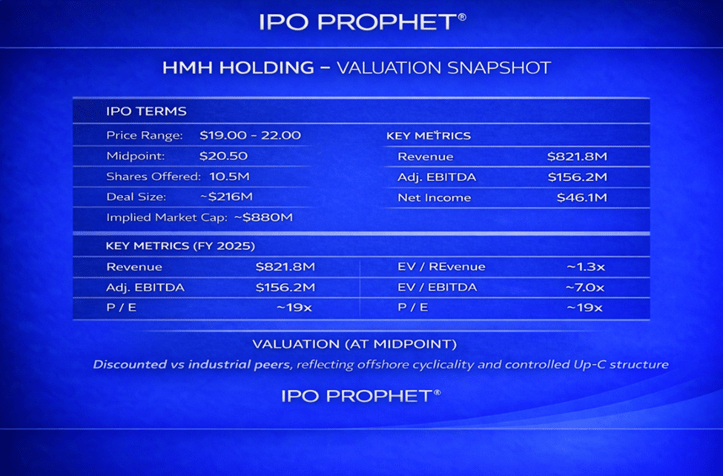
HMH Holding Inc. has filed to go public on the Nasdaq Global Select Market under the ticker HMH, offering 10.52 million shares of Class A common stock at an indicated price range of $19.00 to $22.00 per share, implying gross proceeds of approximately $216 million and an estimated market capitalization of approximately $880–$900 million at the midpoint ($20.50). The offering is being led by J.P. Morgan, Piper Sandler, and Evercore ISI, with Citigroup, DNB Carnegie, Stifel, and Nordea also participating.
HMH enters the public markets as a differentiated provider of mission-critical drilling equipment, services, and systems, with a business model centered around a large installed base and recurring aftermarket revenue. The company was formed through the combination of Baker Hughes’ Subsea Drilling Systems pressure control business and Akastor’s MHWirth drilling equipment operations, creating a scaled platform with deep technical expertise and long-standing customer relationships across the offshore oil and gas ecosystem.
The company’s core value proposition is built around supplying highly engineered equipment that is essential to the safe and efficient operation of drilling rigs, particularly in offshore environments where regulatory standards and technical requirements are significantly higher. Its product portfolio spans pressure control systems such as blowout preventers, topside drilling equipment including hoisting and rotating systems, and a growing suite of digital solutions designed to enhance performance and reduce downtime. These offerings are complemented by a global service infrastructure that supports customers throughout the lifecycle of their assets.
A defining characteristic of the HMH model is its recurring revenue base, driven by aftermarket services and spare parts tied to its installed equipment footprint. In 2025, approximately 74% of revenue was generated from aftermarket services and spare parts, reflecting the durability of demand once equipment is deployed in the field. This dynamic is particularly important in offshore drilling, where equipment is subject to regulatory recertification cycles and continuous maintenance requirements, often over multi-decade operating lives. As a result, HMH benefits from long-term customer relationships and predictable service revenue streams, even in periods of lower newbuild activity.
From a financial perspective, the company presents a relatively balanced profile compared to many industrial IPO candidates. HMH generated $46.1 million of net income in 2025, with adjusted EBITDA margins of approximately 19%, supported by an asset-light operating model that limits capital expenditure requirements to roughly 2–3% of revenue. This combination of profitability and capital efficiency is likely to be a central component of the investment case, particularly in a market environment that is prioritizing cash flow durability over purely top-line growth.
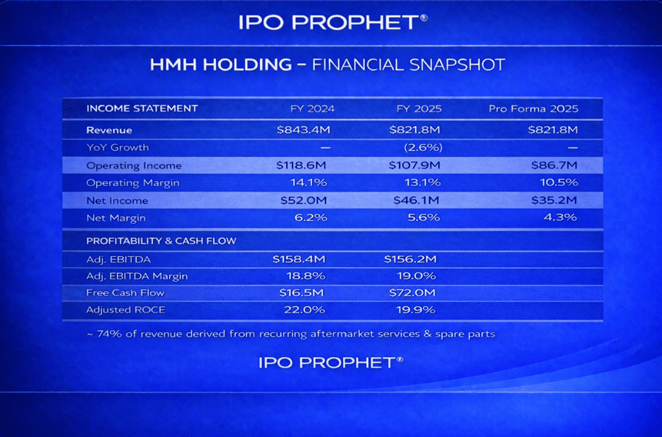
The financial profile reflects a business that is less about high-growth expansion and more about durability and operating efficiency. While revenue declined modestly year-over-year, profitability metrics remained stable, with adjusted EBITDA margins holding near 19%. More notably, free cash flow expanded significantly to $72 million in 2025, highlighting the underlying cash-generative nature of the model as activity levels improve and working capital normalizes.
The broader industry backdrop is also turning more constructive. After a prolonged period of underinvestment, offshore and international drilling activity is beginning to recover, supported by rising energy demand and increasing capital expenditures across the oil and gas sector. HMH is positioned to benefit from this shift not only through potential new equipment orders, but more importantly through increased utilization of its installed base, which drives higher demand for services, re-certifications, and replacement parts.
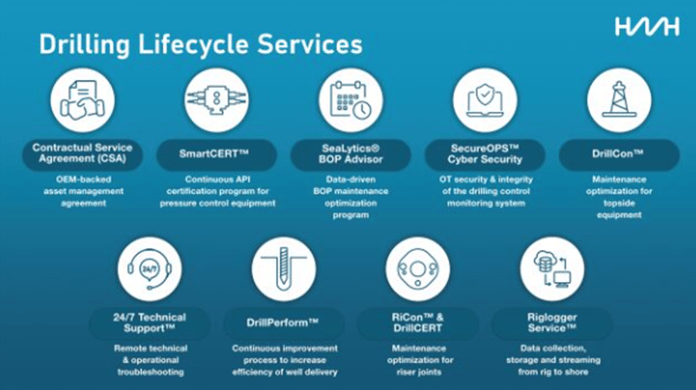
At the same time, the company is expanding its capabilities beyond traditional drilling equipment into adjacent markets such as mining, while also investing in digital solutions that enable remote monitoring, predictive maintenance, and automation. These initiatives are designed to enhance operational efficiency for customers while creating incremental recurring revenue opportunities for HMH. The integration of hardware, services, and software positions the company closer to a lifecycle solutions provider than a traditional equipment manufacturer.
Structurally, the IPO will be executed using an Up-C structure, where the public company owns a minority interest in the operating entity while legacy owners retain their stakes and control at the OpCo level, typically preserving tax advantages and governance control. In HMH’s case, Baker Hughes and Akastor will retain significant voting control through Class B shares. As with other controlled-company structures, governance will be an important consideration for public investors, particularly in balancing long-term strategic control with minority shareholder interests.
At the midpoint of the proposed range, HMH is valued at approximately 7.0x EV/EBITDA and 1.3x revenue, positioning the offering at a discount to many industrial and energy services peers. The valuation appears to reflect both the cyclical nature of offshore drilling activity and the company’s controlled Up-C structure, while also acknowledging the strength of its recurring aftermarket revenue base and margin profile.
From a risk perspective, HMH remains exposed to the cyclical nature of the oil and gas industry, with demand ultimately tied to commodity prices, capital spending cycles, and global energy markets. While the aftermarket-heavy model provides some insulation, new equipment orders and overall activity levels can still fluctuate meaningfully across cycles. In addition, the offshore market’s high barriers to entry also come with concentration risk, as customers tend to be large, sophisticated operators with significant negotiating leverage.
Ultimately, HMH’s IPO represents a play on a recovering offshore drilling cycle, anchored by a business model that emphasizes recurring revenue, capital efficiency, and mission-critical product positioning. The combination of stable margins, improving free cash flow, and a discounted valuation relative to peers creates a balanced setup, though execution through the next phase of the offshore cycle will remain the key determinant of long-term performance. In a market that is increasingly selective and focused on fundamentals, HMH enters the public arena with a profile that combines industrial stability with cyclical upside.
Source: HMH Holding Inc. S-1/A filing
Expected to trade: April 1, 2026