



December 2025 is shaping up to be one of the busiest—and most consequential—year-end IPO windows in...
Introduction
In early 2026, we hosted our first IPO Prophet webcast — a moment that, candidly, felt long overdue.
For years, IPO Prophet has existed largely behind the scenes: quietly built, iterated on, and pressure‑tested in real market conditions. Our work has lived in data pipelines, trading logs, regime models, and daily decision‑making rather than in glossy presentations. The webcast marked a shift. It was our opportunity to step back, synthesize what we’ve learned, and share — in a structured way — how the IPO market actually behaved in 2025 and what that behavior implies as we look ahead to 2026.
This report is an expanded and written version of that discussion.
We wanted to make the slides and commentary available to those who were unable to attend live, but more importantly, we wanted to take the time to deepen the analysis beyond what a one‑hour webcast allows. IPO markets are episodic by nature. They do not move smoothly, and they are often misunderstood precisely because they are judged through narrow windows or headline narratives. Our goal here is to slow the conversation down, contextualize the data, and explain what we believe actually mattered — and what didn’t — over the past year.
At IPO Prophet, we approach IPOs as a market unto themselves. Not an extension of large‑cap equities. Not a proxy for sentiment headlines. And not something that can be reduced to a single statistic like average first‑day returns. IPOs are an event market — driven by issuance mechanics, allocation dynamics, early liquidity formation, and behavioral feedback loops that evolve rapidly in the opening days and weeks of trading.
The 2025 IPO market was a textbook example of why that distinction matters.
On the surface, activity appeared uneven. Windows opened briefly, closed abruptly, and reopened again under different leadership. Beneath the surface, however, something more constructive was happening. Deal quality improved. Price discovery became more disciplined. Early trading outcomes began to normalize. And importantly, the market started to relearn how to absorb risk without requiring perpetual momentum.
This report builds around three core ideas that shaped both the webcast and our ongoing research:
-
IPO markets operate in regimes, not trends. Understanding where we are in that regime cycle matters far more than reacting to individual deals in isolation.
-
Early trading behavior contains durable information. The first day — and often the first hour — tells you more about future outcomes than months of backward‑looking fundamentals.
-
Discipline, not optimism, is what restores confidence. The healthiest IPO markets are not the most explosive ones; they are the ones where buyers and sellers re‑engage under transparent, repeatable rules.
Throughout this report, we expand on the original slides with additional data, examples, and narrative context drawn directly from the IPO Prophet platform. We revisit the signals we introduced — including Bull, Momentum, and Absorption dynamics — and explain how they behaved across different issuance environments. We also introduce our IPO Market Oscillator framework in greater detail, highlighting how regime shifts manifested in real time rather than in hindsight.
Our intention is not to predict headlines or make grand claims about the next blockbuster IPO. Instead, it is to offer a practical, data‑driven lens for interpreting IPO market structure as it actually exists — imperfect, nonlinear, and deeply human.
For readers who joined us live, we hope this report adds depth and clarity to the discussion. For those encountering IPO Prophet for the first time, we hope it provides a useful entry point into how we think about new issuance markets — and why we believe they deserve their own analytical toolkit.
The sections that follow expand directly on the webcast material, moving from a review of 2025 issuance dynamics into a forward‑looking discussion of what conditions would meaningfully change the opportunity set in 2026.
— IPO Prophet
Tales From the Tape to the Next Trade
What the 2025 IPO Market Revealed — and What It Means for 2026
IPO Prophet Perspective
At IPO Prophet, we approach the IPO market as its own ecosystem — one governed by capital formation, liquidity timing, and behavioral asymmetry. IPOs are not simply equities at time zero. They are events. And like all events, their outcomes are shaped as much by how they trade as by what they represent fundamentally.
The 2025 IPO market delivered a clear message. Issuance returned. Participation improved. But behavior did not revert to prior-cycle norms. The market reopened — it did not reset.
What follows is an expanded interpretation of what the tape revealed in 2025, drawing directly from the charts and observations presented in our webcast. We focus less on headline deal performance and more on the mechanics underneath: how risk was priced, how liquidity formed, and how early trading behavior resolved. Those dynamics — not anecdotal winners or losers — are what matter as we move into 2026.
1. Recovery Without Excess: IPO Cycles Reassert Themselves
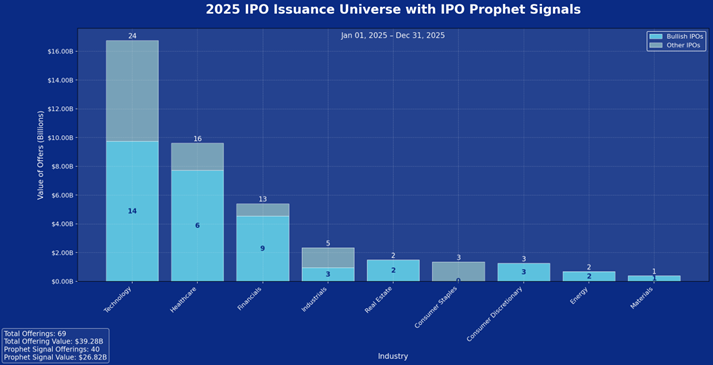
IPO issuance is cyclical by design. Capital formation expands when liquidity is abundant and contracts sharply when risk tolerance disappears. After the near-total collapse of issuance in 2022 and the hesitant false starts of 2023–2024, 2025 represented a genuine recovery phase.
But note the distinction: this was a recovery in function, not exuberance.
Issuance increased meaningfully, yet deal selection remained disciplined. Institutional participation returned, but allocations were earned rather than assumed. From a cycle perspective, 2025 looks far more like early-to-mid normalization than a return to late-cycle enthusiasm.
Markets do not forget stress easily. The scars of the prior cycle — mispriced growth, forced liquidity events, and broken aftermarket performance — were still present in pricing behavior. That memory acted as a governor on excess.
IPO takeaway: The market reopened — but it did so with memory.
2. Premium Dispersion: Normalization, Not Euphoria
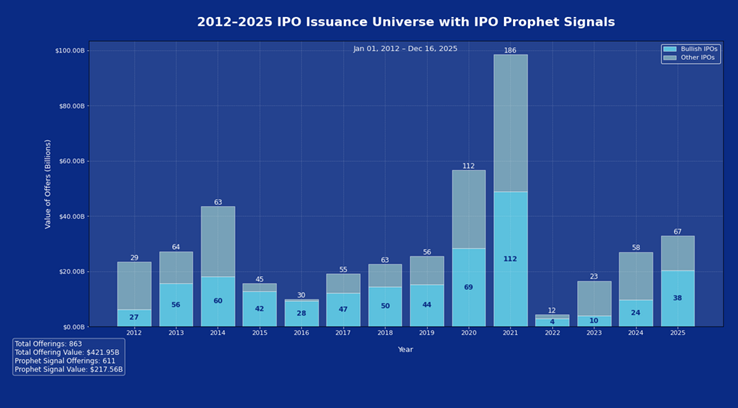
Opening-day premiums remain one of the cleanest indicators of how risk is being priced at the moment private assets transition to public markets. In 2025, what stood out was not simply improving medians, but widening dispersion.
This matters.
Late-cycle IPO markets are defined by uniform upside and compressed downside — a sign that price sensitivity has vanished. By contrast, 2025 showed improving central tendency alongside a broader distribution of outcomes. Upside existed, but it was selective. Extreme outliers were fewer. Losers were punished faster.
This pattern is consistent with a market relearning how to price risk rather than chasing it indiscriminately.
IPO takeaway: Dispersion is healthy. Uniform upside is not.
3. A Narrow Market by Design
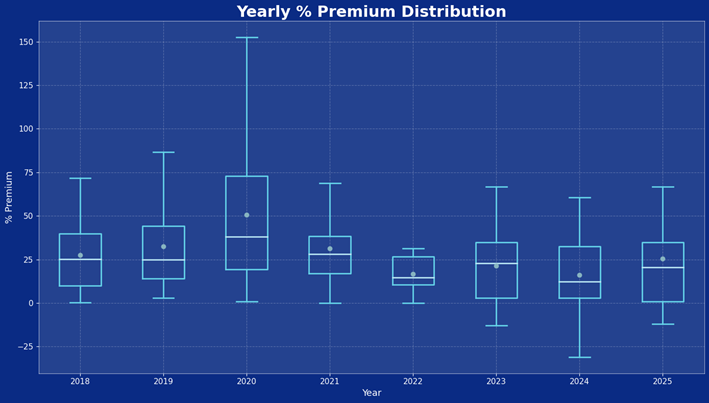
IPO activity in 2025 was highly concentrated by sector. Technology, Financials, and Healthcare accounted for the majority of issuance, with Technology dominating capital formation.
Bull Signals clustered in these same areas.
This concentration was not accidental. It reflected where institutional demand existed — and where it did not. Capital flowed toward businesses with clearer monetization paths, scale advantages, or balance-sheet durability. Other sectors remained largely sidelined.
Early recovery cycles are rarely broad. Conviction leads breadth, not the other way around.
IPO takeaway: Breadth lags early in recovery cycles. Conviction leads.
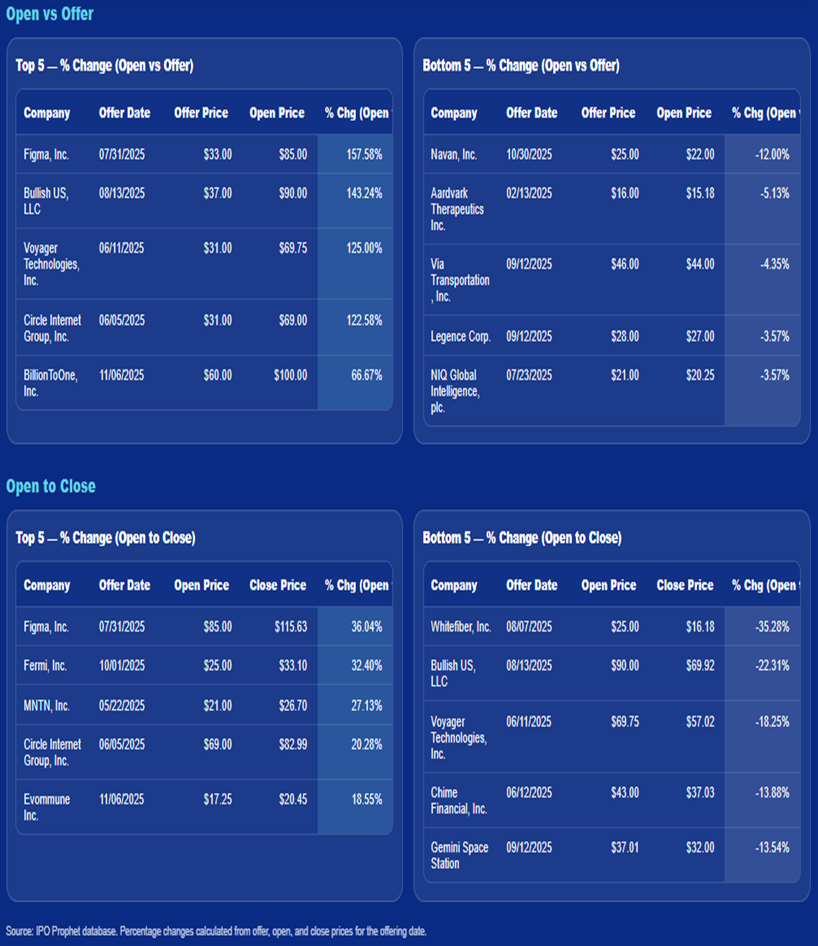
4. First-Day Outcomes: Bifurcation Over Balance
One of the defining features of 2025 was the sharp divergence between first-day winners and losers — often within the same market environment.
Strong opens did not guarantee follow-through. Weak opens frequently accelerated lower. Downside moves developed faster than upside continuation, particularly once early liquidity providers stepped back.
This is not a market struggling to discover price. It is a market struggling to sustain it.
In this environment, the open functions less as confirmation and more as exposure.
IPO takeaway: The open is no longer confirmation — it’s exposure.
5. Deal Size Has Changed the Game
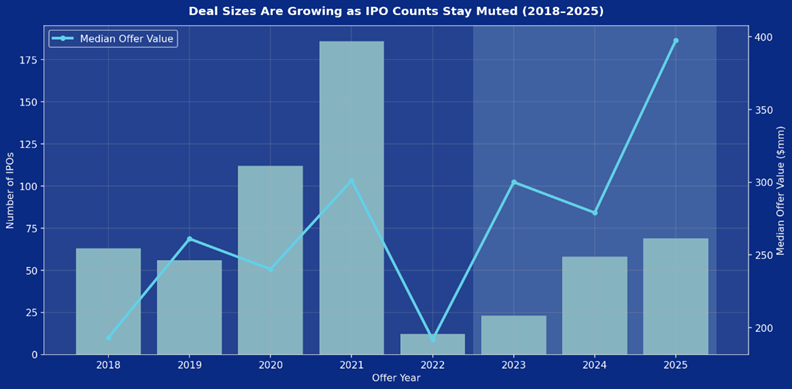
The companies coming public in 2025 were larger, more mature, and further along operationally than in prior cycles. Median deal size increased meaningfully despite muted issuance counts.
This reflects several structural shifts:
-
Longer private-market funding cycles
-
Higher cost of capital
-
Sponsors waiting for scale before public transition
Larger deals behave differently. Liquidity formation takes longer. Allocations are heavier. Early price discovery becomes more sensitive to supply digestion.
IPO takeaway: Bigger deals change the physics of trading.
6. Private Equity’s Return Signals Structural Repair
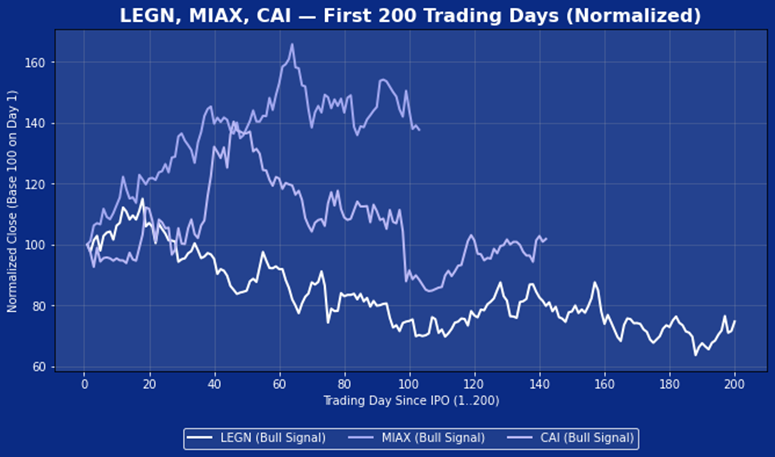
The re-emergence of private-equity sponsored IPOs in 2025 was not merely symbolic — it was structural.
These deals tended to be more conservatively priced, cleaner in capital structure, and better aligned across stakeholders. Sponsors appeared focused on successful public transitions rather than short-term exits.
That shift matters. It improves aftermarket stability and reinforces confidence among institutional participants.
IPO takeaway: Sponsor behavior is a cycle signal — and private-equity-driven offerings fared well.
7. Mega IPOs Are a Different Test Entirely
Late-stage private leaders loom over the 2026–2027 calendar. These offerings will test the limits of retail demand, institutional risk tolerance, and opening mechanics.
The key question is not whether these deals will trade — but who controls price discovery.
Early evidence suggests retail interest will drive attention and volatility, while institutions continue to anchor valuation frameworks.
IPO takeaway: Narrative may move price — size sets limits.

8. Turnover Returned — Selectively
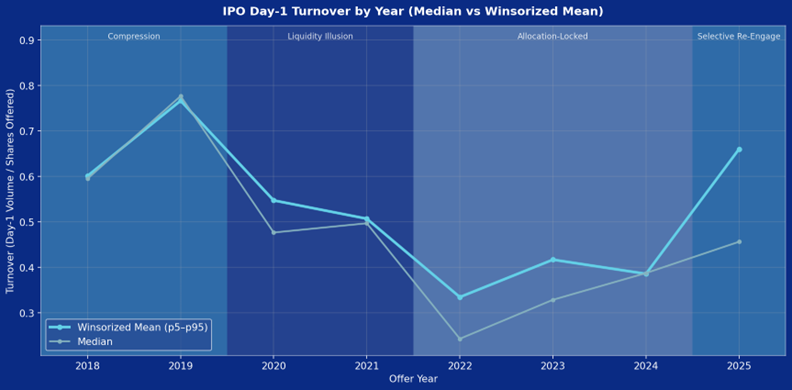
Day-one turnover rebounded in 2025, but unevenly. Winsorized turnover increased materially, while medians remained constrained.
This divergence signals selective engagement rather than broad participation. Where price discovery worked, capital showed up. Where it didn’t, it didn’t.
Turnover regained informational value.
IPO takeaway: Activity is no longer automatic — it’s diagnostic.
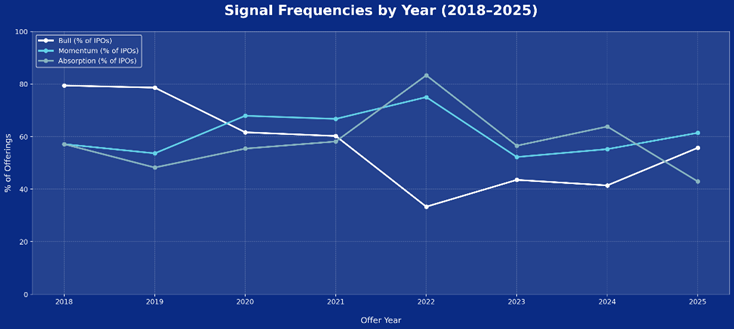
9. What Signal Frequency Tells Us About Environment
Signal frequency provides critical context for how IPOs behave across cycles.
In 2025:
-
Bull Signals increased, reflecting improving conditions
-
Momentum Signals remained elevated, highlighting volatility
-
Absorption Signals pointed to ongoing supply digestion challenges
Together, they describe a market that is strengthening — but still unstable.
IPO takeaway: Strength returned before smoothness did.
10. The Open Has Become a Volatility Event
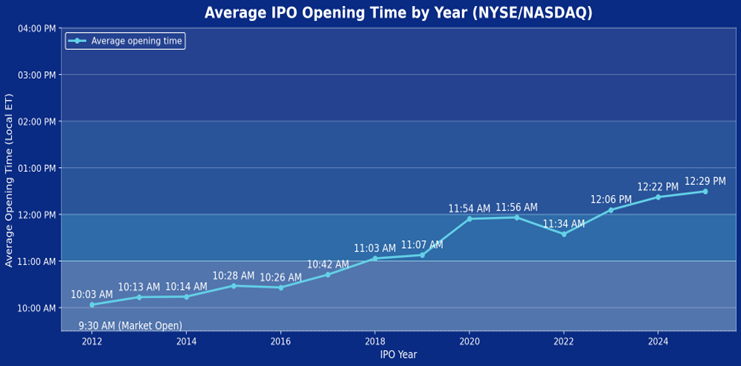
IPO opening auctions are concluding later, with larger opening volumes. But volume no longer guarantees stability.
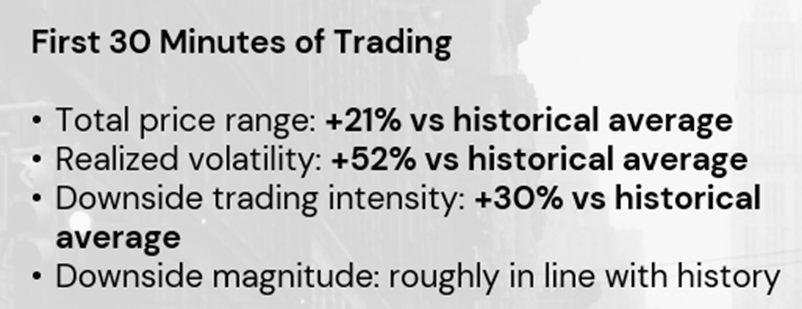
A disproportionate share of total volatility now occurs early. The first 30 minutes routinely define the day’s range, with downside intensity increasing materially.
The open has shifted from discovery to disruption.
IPO takeaway: The first hour now defines the day.
11. Regime Context Matters More Than Ever
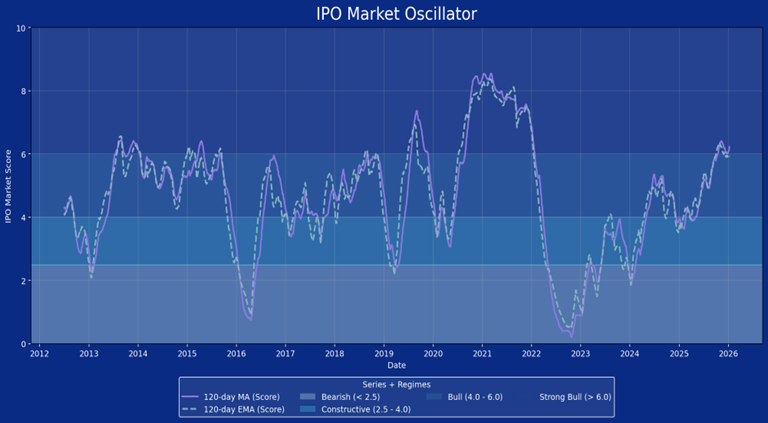
The IPO Prophet Oscillator provides a tape-derived framework for understanding IPO market regimes. It is not predictive — it is contextual.
The same setup behaves differently across regimes. Context determines position sizing, risk tolerance, and momentum expectations.
IPO takeaway: Context determines outcome distribution.
Final Perspective: From Recovery to Opportunity
2025 was not about whether IPOs “worked.” It was about how they traded.
Participation returned selectively. Dispersion widened without excess. Early-session behavior dominated both risk and reward.
As we move into 2026, the edge will not come from chasing issuance. It will come from understanding structure, timing, and regime.
Execution discipline over allocation size. Early risk management over opening pops. Contextual signals over static assumptions.
That is where IPO Prophet operates.