
MiniMed Group, Inc. (MMED), a diabetes technology company with approximately $2.3 billion in fiscal...
PayPay Corp (PAYP), a digital payments and fintech platform with deep penetration across Japan’s mobile payments ecosystem, began trading on March 12, 2026 with a mixed first session that ultimately shifted into a clear price discovery phase after the opening trade.
Shares opened at $19.00, representing an 18.75% gain above the $16.00 IPO price. While the opening print reflected positive early demand from public market investors, no Bull signal was triggered during the pre-market indication period, which is the only window in which the IPO Prophet model can establish a bullish stance ahead of the opening trade.
As a result, the framework never generated a buy signal for the stock, meaning the model would have avoided purchasing shares at the open and favored selling any allocated IPO shares into the initial strength.
Shortly after trading began, shares briefly reached an intraday high of $19.29 before momentum began to fade. From that point the stock gradually moved lower through the midday and afternoon sessions as selling pressure built.
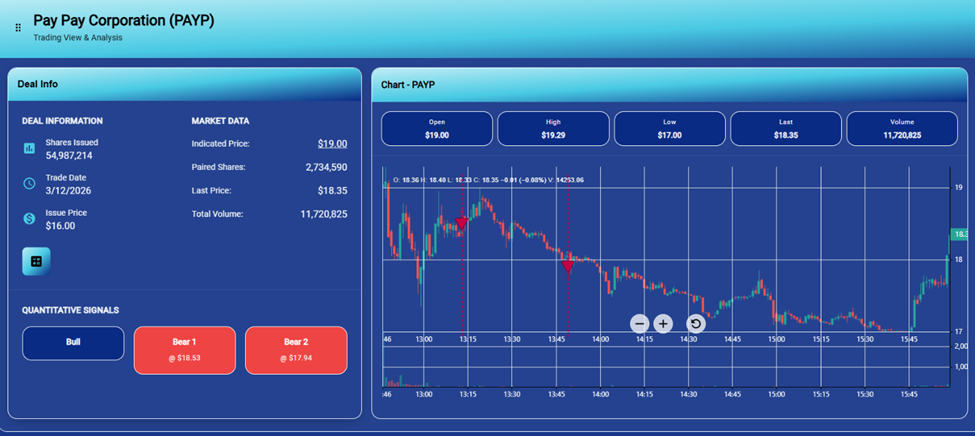
From a signal perspective, both Bear signals activated during the session, providing a framework for the shift in intraday momentum. Bear 1 triggered at $18.53, followed by Bear 2 at $17.94, as the stock continued to weaken during the afternoon session.
Following the activation of the Bear signals, PayPay shares continued to trend lower, ultimately touching an intraday low of $17.00 before stabilizing slightly into the close.
During the final minutes of trading the stock experienced a brief rally, which lifted the closing price to $18.35. While the late bounce improved the appearance of the closing print, the majority of the session was characterized by steady selling pressure following the opening trade.
Total volume reached approximately 11.7 million shares. Given that the IPO issued roughly 55 million shares, first-day trading represented a relatively moderate portion of the newly issued supply as the market began absorbing the offering.
From an IPO Prophet perspective, the signal framework effectively framed the session. The absence of a Bull signal prevented chasing the opening trade, while the two Bear signals correctly identified the shift toward weaker intraday momentum as the stock moved lower through the afternoon.