

Rezera Inc. (Nasdaq Global Market: RZRA) set terms for its initial public offering in a November 5 S-1 amendment, proposing to sell 16.67 million shares at $11 to $13 per share. At the $12 midpoint, the Boston-based biotech would raise $200 million in gross proceeds and have an implied basic market capitalization of approximately $249 million, based on 20.78 million shares outstanding after the offering. Jefferies, TD Cowen, and Cantor are the joint bookrunners, and Wedbush PacGrow is the lead manager. Rezera estimates $181 million in net proceeds at the midpoint. Yatırım Masası
Can lower inflammation help patients walk farther?
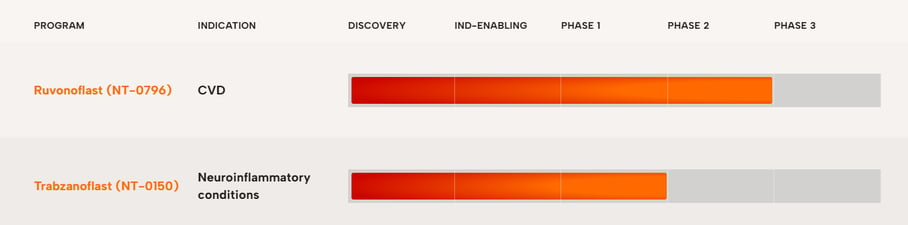
Rezera, formerly NodThera, is developing oral drugs that inhibit NLRP3, a protein involved in triggering inflammation. Its lead candidate, ruvonoflast, is headed toward a pivotal trial in peripheral artery disease (PAD). In symptomatic PAD, reduced blood flow to the legs can make walking painful and limit how far patients can go. Rezera’s hypothesis is that lowering inflammation could improve walking ability in patients who still have elevated inflammation despite standard care.
Rezera reported reductions in inflammatory markers in its Phase 2 cardiometabolic studies. The next step is to show that those changes translate into a benefit patients can feel. The planned RELIEVE-PAD trial would enroll about 800 patients, compare ruvonoflast with placebo, and measure maximum walking distance after approximately 12 months. Rezera plans to start the trial in the first half of 2027 and report results in 2028. The earlier studies were conducted outside PAD, so the pivotal trial will provide the first direct test of this walking benefit in the intended patient population.
Rezera’s second candidate, trabzanoflast, is designed to reach the brain and target neuroinflammation. It has completed Phase 1, and Rezera plans a Phase 2 proof-of-concept study. Management expects the IPO proceeds to carry ruvonoflast through its planned Phase 3 readout, while trabzanoflast’s Phase 2 readout would require additional funding under the current plan.
What GSK would get for its investment
GSK affiliate Glaxo Group Limited has indicated interest in purchasing up to $25 million of stock at the IPO price. At the midpoint, that would represent 12.5% of the offering and roughly 10% of Rezera’s post-IPO shares. The indication is nonbinding. A qualifying $25 million purchase would activate rights to negotiate first over access to certain Phase 3 data, a potential sale of ruvonoflast, and a potential change of control of Rezera. The arrangement also provides for GSK participation on a clinical advisory board.
The structure gives GSK a chance to follow the program closely and negotiate first on specified transactions. For IPO investors, the distinction matters because the agreement gives GSK an opportunity to pursue a deal while leaving any future transaction up to both parties.
Financials and cash runway
Rezera has no product revenue. In the first half of 2026, R&D spending nearly doubled to $19.9 million, driven primarily by higher spending on ruvonoflast, and net loss widened to $25.5 million from $13.7 million a year earlier.
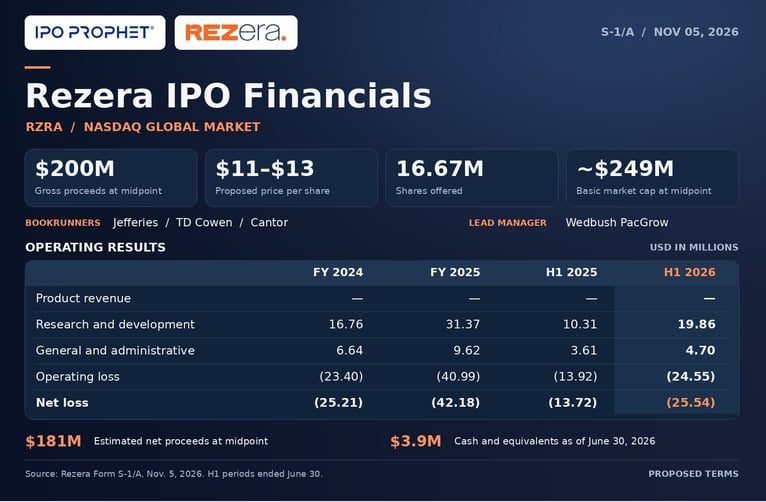
Rezera reported $3.9 million in cash and equivalents as of June 30, 2026. With the estimated IPO proceeds and its existing cash resources, management projects funding through the first quarter of 2029. That puts the expected 2028 Phase 3 readout within the projected runway. A delay in enrollment or a requirement for additional studies could increase the amount of capital Rezera needs before it can seek approval.
What investors should watch
The first checkpoint is whether RELIEVE-PAD starts on schedule in the first half of 2027. From there, enrollment will help determine whether Rezera can deliver results in 2028 within its projected cash runway. The result that matters most is how much farther patients taking ruvonoflast can walk compared with those on placebo. That difference will help investors judge whether the earlier reductions in inflammation translate into a meaningful treatment benefit.