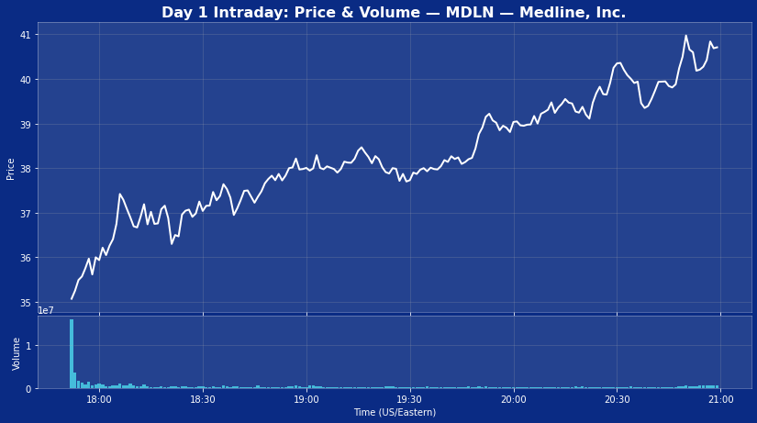
December 17, 2025 — Medline Industries, Inc. (NASDAQ: MDLN) began trading today on the Nasdaq Global Select Market following the pricing of its initial public offering at $29.00 per share. Shares opened at $35.00 in their first public trade, representing an immediate gain of approximately 21 percent, and continued to build momentum throughout the session. By the close, the stock finished near $41.00, delivering a first-day increase of roughly forty percent and marking one of the most consequential IPO debuts of 2025.
Medline’s first day as a public company delivered a clear signal that the U.S. new-issue market is once again willing to absorb size. The company raised more than $6 billion in gross proceeds, making it the largest U.S. IPO in several years and a defining healthcare listing for the post-pandemic era. In a market where many recent offerings have been intentionally small and cautiously structured, Medline’s deal represented a return to large-scale issuance, and the market’s ability to digest it without disruption suggests a healthier demand environment than has existed since 2021.
From a trading perspective, the stock’s behavior stood out for its quality as much as its magnitude. Opening materially above the IPO price set a strong tone, but the ability to extend gains and close near the highs of the day was more telling. That pattern typically reflects sustained institutional participation rather than short-term trading activity, signaling interest from long-only funds and allocators building positions rather than flipping shares.
Investor reception was closely tied to Medline’s business profile. Unlike many recent IPOs that relied heavily on forward-looking growth narratives, Medline entered the public markets as a long-established, scaled healthcare supplier with recurring demand and deep customer relationships. Founded in 1966, the company operates at the core of the medical supply chain, a segment that benefits from defensive characteristics and steady utilization across economic cycles. In an environment still shaped by macro uncertainty, that stability resonated with investors.
The IPO also carried broader significance in the context of private equity and capital structure normalization. Medline was taken private in a large sponsor-led transaction in 2021, and the return to public markets provided an opportunity to reduce leverage and strengthen the balance sheet. IPOs centered on deleveraging tend to attract a different class of investor than those focused on aggressive expansion, particularly in a higher-rate environment where balance-sheet discipline has regained prominence.
Beyond the company itself, Medline’s debut is increasingly being viewed as a bellwether for the broader IPO market heading into 2026. For much of the past several years, issuance was constrained by volatility, valuation disconnects, and investor fatigue following the excesses of the prior cycle. Medline’s success suggests that investors are again willing to engage with new listings, especially when companies come to market with scale, operating history, and clear economic fundamentals.
That said, first-day trading represents only the initial chapter of Medline’s life as a public company. As stabilization periods expire and lockup dynamics come into focus, attention will shift toward execution, cash flow generation, and leverage reduction. Large sponsor-backed IPOs often face a more deliberate aftermarket as supply normalizes and valuation becomes anchored to quarterly performance rather than scarcity.
Even so, the message delivered by Medline’s debut is difficult to overlook. The IPO demonstrated that size is no longer a deterrent when fundamentals align with investor priorities. It reinforced demand for durable, cash-flow-oriented healthcare businesses and helped restore confidence that the U.S. equity capital markets can support large, complex offerings once again. As the IPO calendar builds toward 2026, Medline’s first day of trading is likely to be remembered as one of the transactions that helped reopen the door.